How it works Race predictions and threshold
Race predictions and lactate threshold
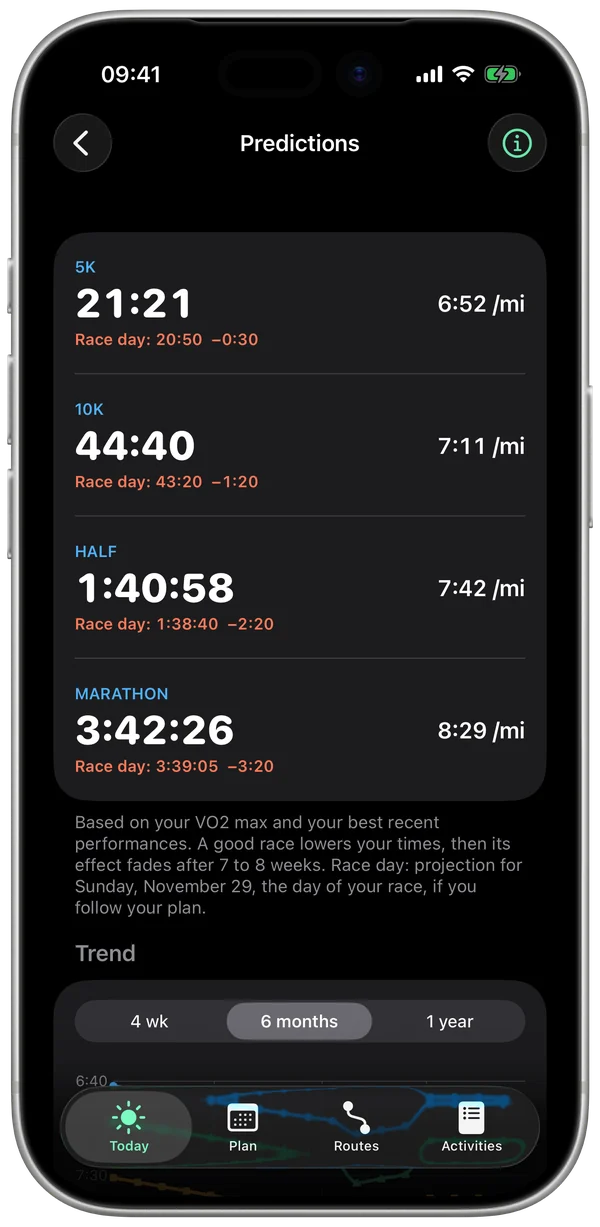
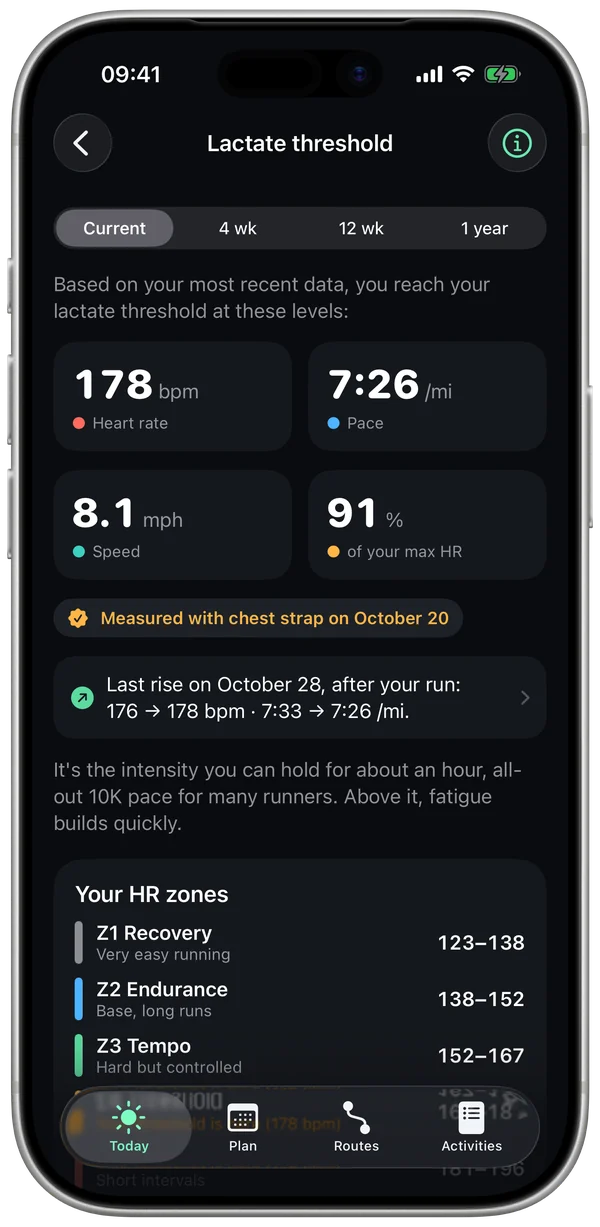
The time you could run today from the 5K to the marathon, plus the pace and heart rate at your threshold, which set your workouts.
What Stamio uses
- Your VO2 max.
- Your best efforts over 5K, 10K, half marathon and marathon, measured within your outdoor runs.
- The race results you enter for races run without your watch.
- Your heart rate during your sustained efforts, and your max HR.
- With a chest strap paired with Stamio and your iPhone on you: the gap between each heartbeat, during your runs.
How it's calculated
A time based on your VO2 max
Published tables link VO2 max to the time you can hold over each distance. Stamio starts from there, with a safety margin that narrows for highly trained runners.
A time based on your runs
Each recent best effort is carried over to the other distances using the published relationship between distance and race time. A good run brings your times down, then its effect fades after 7 to 8 weeks.
The faster of the two
Your predicted time is the better of the two. So a strong race counts right away, even if your VO2 max hasn't moved yet.
Your threshold heart rate
It comes from your most recent sustained efforts (the highest heart rate you held for about ten minutes) and from a share of your max HR. A hard run raises it, then it comes back down slowly.
Your threshold pace
It's derived from your predicted 10K time, and stays at its best level for a few weeks rather than moving with every workout. The "Threshold" workouts in your plan are run around this pace.
Your measured threshold, with a chest strap
At threshold, your breathing picks up and your heart rhythm becomes very regular: the gap between two beats barely varies anymore. A chest strap picks up your heart's electrical signal and timestamps each beat to the millisecond. During your run, Stamio spots the moment this variability drops below the level described in published research: your heart rate and pace at that moment give your measured threshold. One workout with 10 to 15 minutes near your threshold is enough. This measurement is still marked "Experimental".
Your heart rate zones
They're calculated on your heart rate reserve, between your resting HR and your max HR, and are used for your easy runs, your run maps and your load.
When it changes
- After every outdoor run: a new VO2 max, a possible new best effort.
- When you enter a race result (5K or longer, less than 200 days old).
- After a run that raises your threshold, the run details say so: "New threshold".
- With a plan, each time also has its race-day projection (see the Plan page).
What can throw it off
- The marathon takes endurance: its predicted time assumes you've trained for it, long runs included.
- A very hilly course, heat or wind: on race day, your time will be slower than the predicted time on flat ground.
- A GPS distance that's too long on a run: a best effort can come out a bit too flattering.
- A wrong max HR shifts your threshold heart rate and your zones.
- A watch, earbuds or an armband measure heart rate well, but not the gap between two beats finely enough to measure threshold: only a chest strap can do that.
- Dry electrodes at the start or a strap that shifts scramble a few beats: Stamio leaves them out.
What you can set
- Add results from races you ran without your watch (My race results): they also count in your records, marked "entered".
- Your max HR and resting HR, which set your zones.
- Pair a Bluetooth chest strap (Settings › Advanced › Chest strap), just once.
Verified
Predicted times were calibrated, then checked against a high-end GPS watch worn at the same time: less than a 0.7% difference from the 5K to the marathon.
Just one runner so far: me. The beta will tell the rest.
Questions
My predicted marathon time seems too fast.
It tells you what your fitness allows if you've trained for the distance. Without long runs, aim more conservatively: a marathon plan will give you a more accurate race-day projection.
Why did my times suddenly drop?
A good recent run was taken into account. Its effect then fades over a few weeks, unless another run confirms it.
Do I need a chest strap for threshold?
No. Without a chest strap, your threshold is calculated from your heart rate and pace during your runs: a reliable estimate, within a few beats. With a chest strap, it can also be measured.
Further reading
- Daniels J., Gilbert J. (1979), Oxygen Power: Performance Tables for Distance Runners, Tempe (Arizona).
- Riegel P. S. (1981), "Athletic records and human endurance", American Scientist, 69(3), 285-290.
- Rogers B., Giles D., Draper N., Mourot L., Gronwald T. (2021), "Detection of the anaerobic threshold in endurance sports: validation of a new method using correlation properties of heart rate variability", Journal of Functional Morphology and Kinesiology, 6(2), 38.
Estimates for training: the weather, the course and how you feel on the day count too.