How it works Workout analysis
Workout analysis
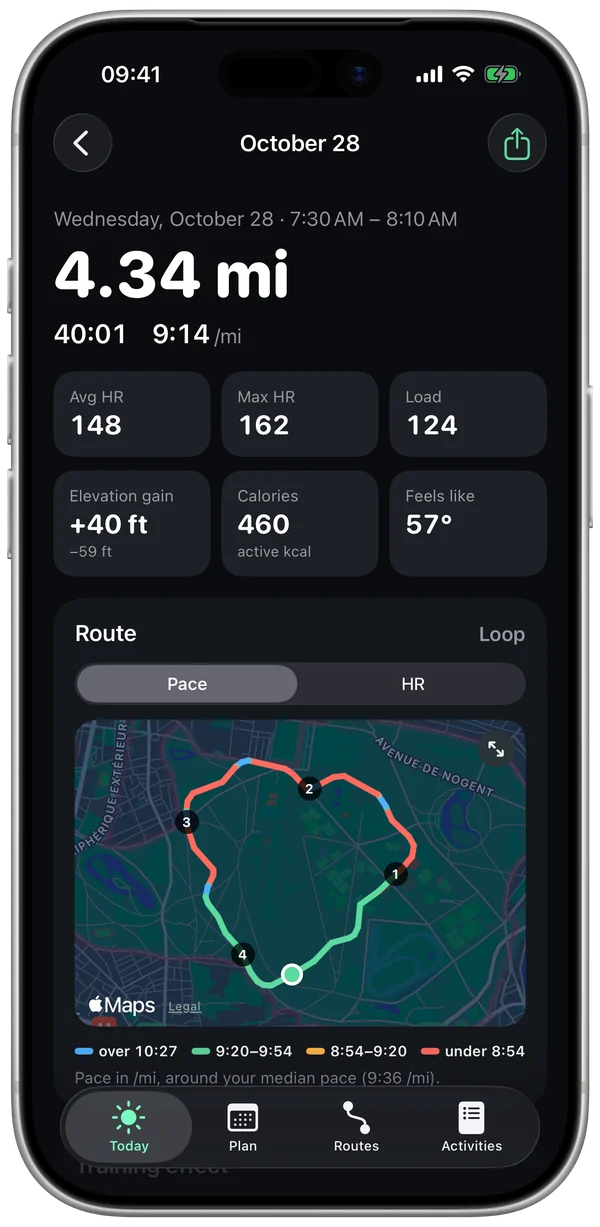
After each workout, Stamio shows you what it did for you, finds your reps on its own, colors your route and tracks your running form. You can also note how it felt and test a change.
What Stamio uses
- Your heart rate, pace and track, second by second.
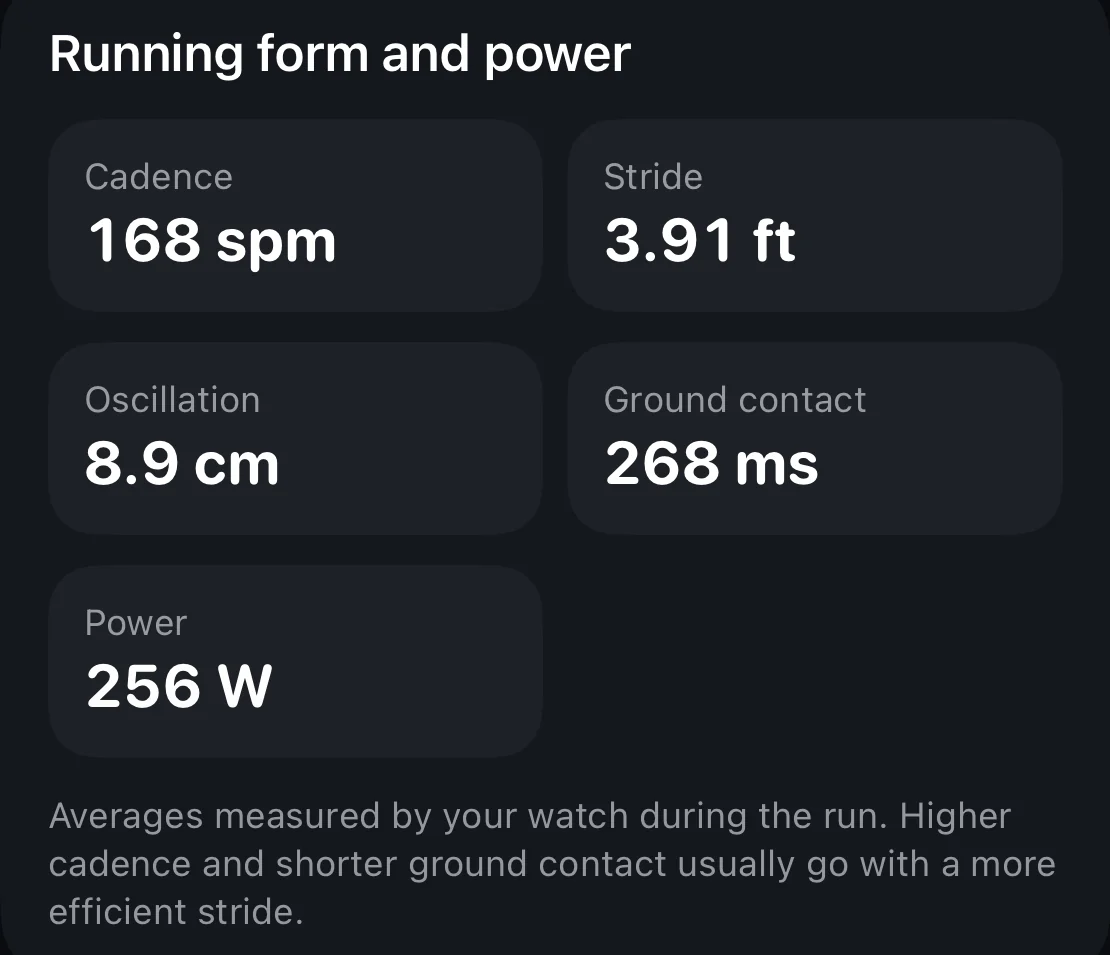
- Your watch's running form metrics: cadence, stride length, vertical oscillation, ground contact time, power.
- What you note after the workout: your perceived effort and how it felt.
How it's calculated
Training effect
The aerobic effect (0 to 5) comes from the oxygen debt the workout left, based on your heart rate relative to your reserve. The anaerobic effect comes from very intense, short efforts. Together, they give the main benefit: Recovery, Base endurance, Tempo, Threshold, VO2 max or Anaerobic, with a sentence that says what it builds.
Steps
A plan workout shows its steps, each judged against its range. Any other run shows the reps Stamio finds on its own, without you marking a lap. A continuous run has no steps: the per-mile table takes their place.
The colored map
Your route is colored in five levels around your median pace for the workout, or by your heart rate zones. Pauses show as dotted lines.
Best efforts and records
Your fastest time over 1 km, 1 mile, 5K, 10K, half marathon and marathon, anywhere in your run. Your record at each distance gets its medal.
Trials
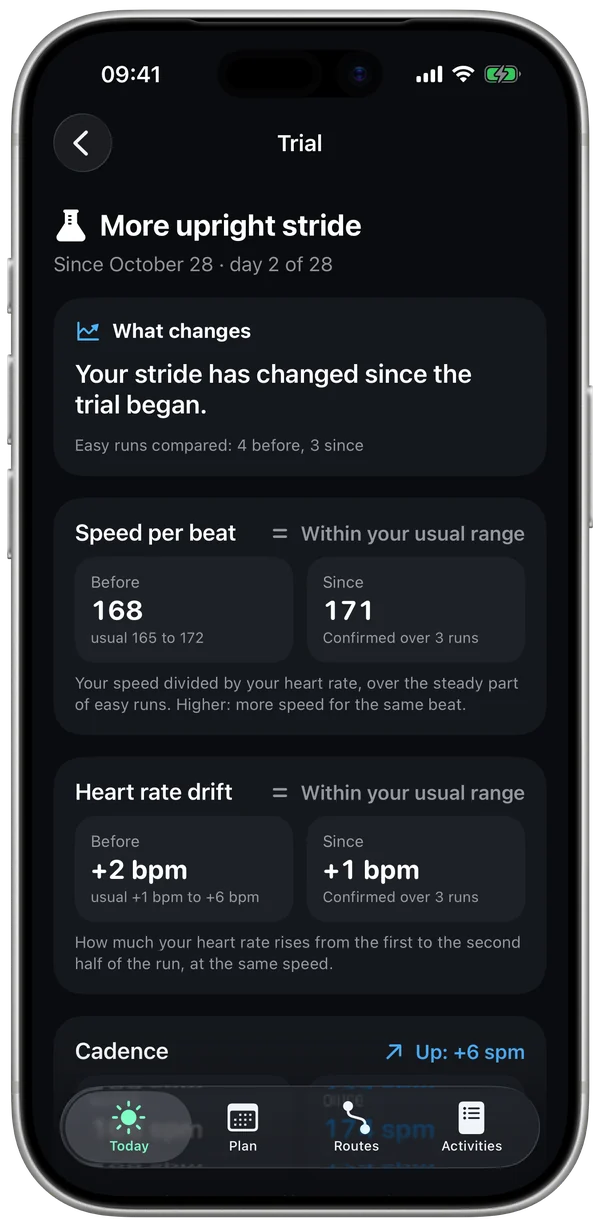
Changing something (stride, shoes…)? Start a 4-week trial: Stamio compares your easy runs before and after on your speed per heartbeat, your heart rate drift, your cadence, your oscillation and your ground contact. The verdict only talks about measurements.
When it's ready
- As soon as the workout is saved to the Health app, by Stamio or by the Workout app.
- The track is only read when you open the details, to keep the app fast.
- A trial builds up over the easy runs that follow.
What can throw it off
- Wrong heart rate: the effect and the load will be wrong too. You can exclude the run, which keeps a load estimated from your pace.
- GPS that jumps: the map and best efforts can show traces of it.
- Running form is only measured while running, by the watches that support it.
What you can do
- Note your perceived effort (written to the Health app) and how it felt: legs, stride, pain, shoes, weather, food.
- Share an image of your run, with its map and numbers.
- Export the workout as GPX or FIT.
- Find all your notes in Activities › Notes.
Verified
Training effect was calibrated, then checked on 89 runs against a high-end GPS watch worn at the same time: ±0.12 with a chest strap, ±0.17 at the wrist.
Just one runner so far: me. The beta will tell the rest.
Questions
Does a pain note change my plan?
No. It stays in your log. If the pain lasts or comes back, talk to a doctor or a physical therapist; you can lighten your week yourself with "Adjust my week".
Why were my intervals found without me marking laps?
Stamio spots clear changes in pace. The rule was checked so it doesn't invent anything on easy runs, long runs and races.
What about a workout that isn't a run?
Every workout has its effect and its load, based on your heart rate. The map, steps and running form are reserved for activities where they make sense.
Further reading
- Moore I. S. (2016), "Is there an economical running technique? A review of modifiable biomechanical factors affecting running economy", Sports Medicine, 46(6), 793-807.
- Børsheim E., Bahr R. (2003), "Effect of exercise intensity, duration and mode on post-exercise oxygen consumption", Sports Medicine, 33(14), 1037-1060.
Estimates for training. A trial's verdict describes measurements, not one technique being better than another.