How it works VO2 max
VO2 max
The maximum amount of oxygen your body can use during exercise. The best marker of your endurance, recalculated by Stamio on every run.
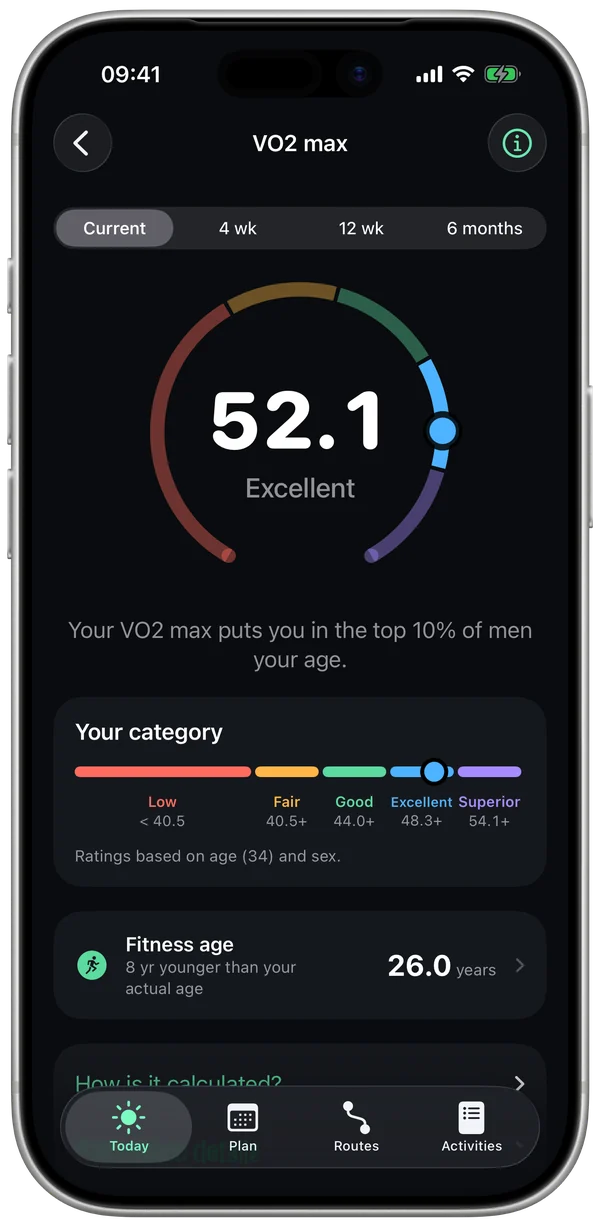
What Stamio measures
- Your heart rate, second by second, at the wrist or with a chest strap.
- Your speed and elevation, from your watch's GPS.
- Your resting HR (during your nights) and your max HR, which follows your peak efforts.
How it's calculated
- 1
The effort your pace demands
Running at a given speed, on flat ground or uphill, costs a known amount of oxygen: that's the basis of the metabolic equations used in exercise physiology.
- 2
How much of your heart it takes
Your heart rate, relative to your heart rate reserve (between your resting HR and your max HR), tells how much of your capacity you're using at that moment.
- 3
The two, put together
The faster you run for the same share of your heart rate reserve, the higher your VO2 max. Stamio only keeps the reliable stretches: steady pace, a fairly sustained effort, without the first minute or the stops.
- 4
A value that changes gradually
Each run gives an estimate that moves your VO2 max a little, never all at once: a sustained, steady workout weighs more than a very slow easy run.
When it changes
- After every outdoor run with GPS, recorded by Stamio or by the Workout app.
- A run that's fast for your heart rate raises it; a run that's slow for your heart rate (fatigue, heat) lowers it a little.
- Treadmill runs, runs without heart rate and runs that are too short count in your load and your plan, but not in your VO2 max.
- If you run slowly, alternating walking and running, Stamio learns from that too, using your steadiest running stretches.

What can throw it off
- A wrist sensor that's badly placed or too loose (heart rate too high or dropping out): you can exclude the run, and your VO2 max is then recalculated without it.
- A wrong max HR: by default, it starts from 220 − age, then follows your peaks. If you know yours (from a stress test), enter it.
- Disrupted GPS (buildings, dense forest, tunnel): doubtful stretches are left out, though not always all of them.
- Medication that slows your heart: the relationship between your heart rate and your effort changes, and so do the values.
What you can set
- Your max HR and resting HR (Settings › Heart rate and zones).
- A known VO2 max, from another watch or a test: a starting point from that day on, and your past trend is kept. By default there's nothing to enter: it's learned from your runs.
- Exclude a run whose heart rate was wrong (run details).
Verified
Calibrated, then checked on 109 runs compared day after day with a high-end GPS watch worn at the same time: an average difference of 0.28.
Just one runner so far: me. The beta will tell the rest.
Questions
Why is it different from the one in the Health app?
Stamio has its own calculation engine, built for running: it never reuses the Health app's VO2 max. That one is estimated differently, during walking and running, and it's often underestimated in runners: 6 points lower on average than a lab test in an independent study (PLoS ONE, 2025). Stamio calculates its own from your runs, with your heart rate reserve and your max HR, and never mixes the two.
My VO2 max dropped after an easy run. Am I losing fitness?
No. An easy run in strong heat, while tired, or with an imprecise sensor can lower it a little. What matters is the trend over several weeks, and your training status watches it for you.
How long before my first value?
One or two outdoor runs, at a steady pace for at least a few minutes. If you were already wearing your Apple Watch, Stamio reads back your past runs and your value is there from the first calculation.
What about wheelchair, cycling or swimming?
Stamio only calculates VO2 max for running, where the method is reliable. In wheelchair mode, it isn't shown, so you don't get a wrong value.
Further reading
- American College of Sports Medicine, ACSM's Guidelines for Exercise Testing and Prescription: metabolic equations for running and walking.
- Lambe R., O'Grady B., Baldwin M., Doherty C. (2025), "Investigating the accuracy of Apple Watch VO2 max measurements: A validation study", PLoS ONE, 20(5), e0323741.
- Swain D. P., Leutholtz B. C. (1997), "Heart rate reserve is equivalent to %VO2 reserve, not to %VO2max", Medicine & Science in Sports & Exercise, 29(3), 410-414.
An estimate for wellness and training, not a lab measurement. It can vary with your watch and how you wear it.