How it works Night and day
Sleep, HRV, resting HR and energy
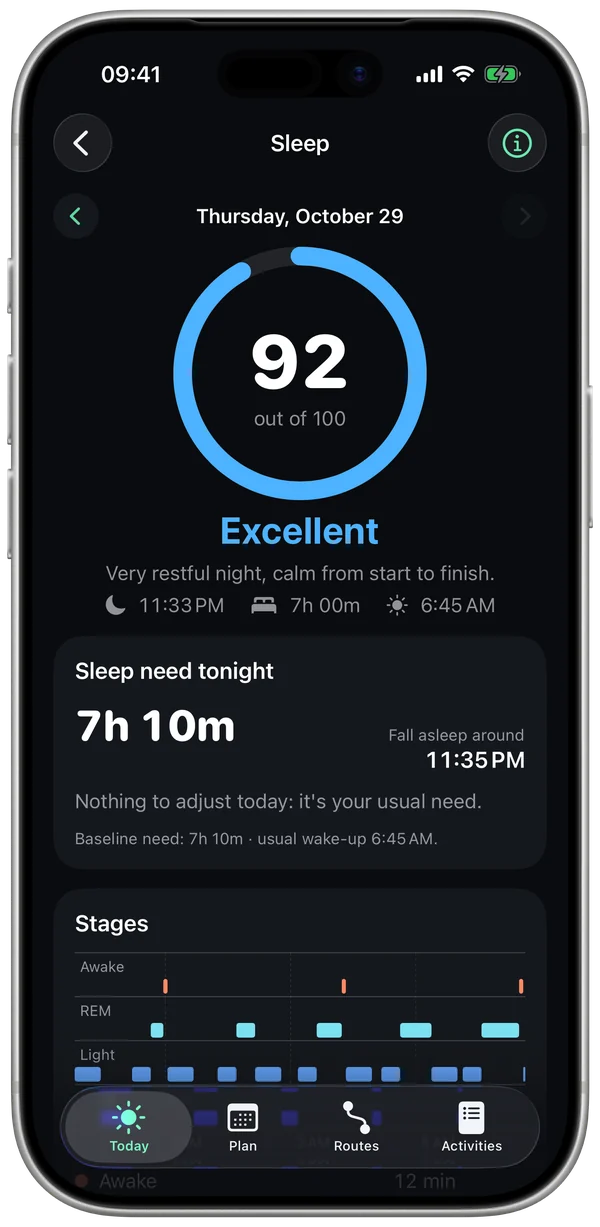
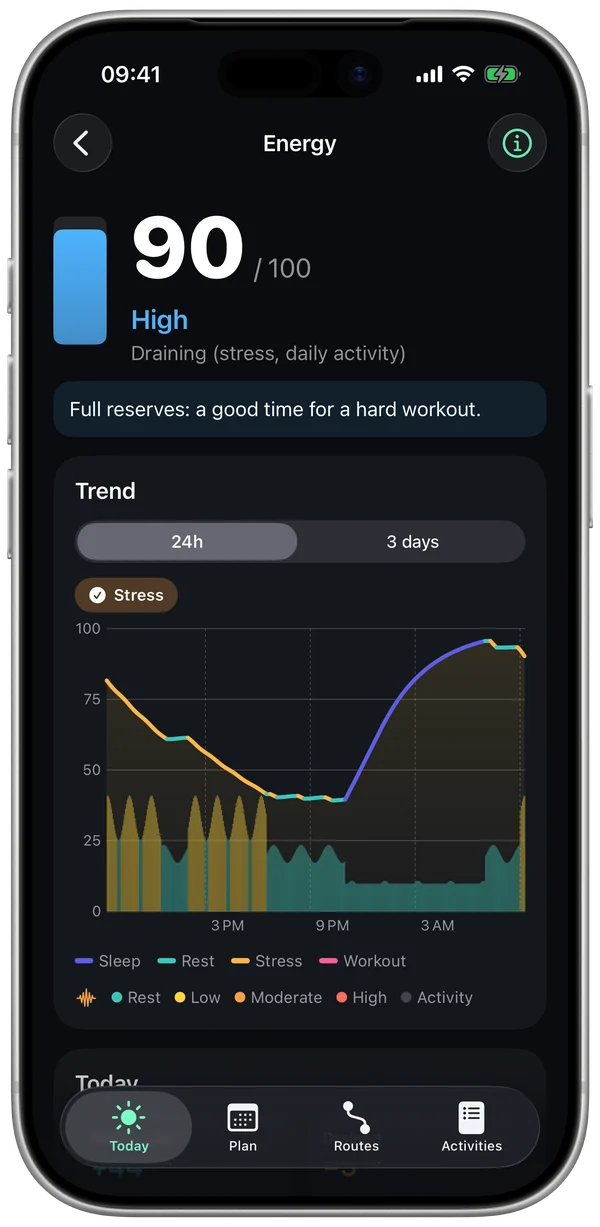
Every night, your watch measures your sleep and your heart. From that, Stamio works out your sleep score, your need for tonight, your HRV and your resting HR, then your energy and stress during the day.
What Stamio uses
- Your sleep stages (awake, light, deep, REM), as your watch measures them.
- Your heartbeats during the night, one by one, for HRV, and your heart rate.
- Your breathing, wrist temperature and blood oxygen, if your watch measures them.
- Your heart rate during the day and your workouts, for energy and stress.
How it's calculated
Sleep score
It starts from an ideal night and takes off points for sleep shorter than your need, high stress during the night (heart rate and HRV), time awake, and too little deep or REM sleep. The stages come straight from your watch, as is. 90 and above: excellent; 80 to 89: good; 60 to 79: fair; below 60: poor.
Your need for tonight
It starts from your baseline need and adjusts for today's training load, last night's sleep, your HRV and your naps. From that, Stamio suggests a bedtime, based on your usual wake-up time.
Your overnight HRV
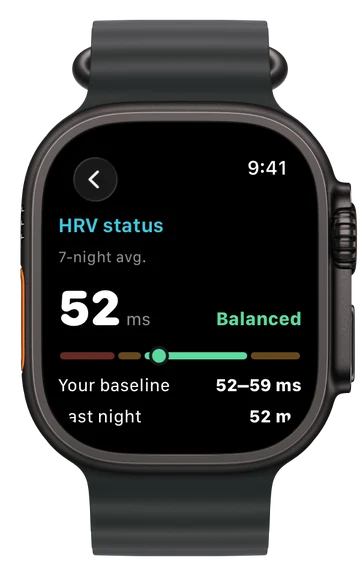
Stamio gathers all of the night's heartbeats and works out the average difference between two successive beats (RMSSD), the measure sports watches use. Poorly measured beats are left out; a naturally high HRV is never penalized.
Your HRV status
The average of your last 7 nights is compared with your usual, set from your previous 60 nights. Inside your band: balanced. Outside it: unbalanced. Well below it: low.
Your resting HR
It's the level your heart rate drops below only 10% of the time during your night: steadier than a single reading. It's compared with your usual over the last 30 days. The median of your last 14 nights is the reference for your heart rate zones and your load.
Your energy and stress
Your stress (0 to 100) comes from your heart rate when you're not moving: the further it is above your usual resting rate, the more strained your body is. Your energy, a reserve from 5 to 100, recharges mostly while you sleep, a little while you rest, and drains with stress and workouts.
Your night at a glance
Resting HR, HRV, breathing, wrist temperature and blood oxygen are compared with your own range over the last 30 nights. These signs don't change any other calculation: they only tell you whether your night was normal for you.
When it changes
- The score, HRV and resting HR come in when you wake up, once your watch has sent your night.
- Tonight's need is recalculated during the day, after a workout or a nap.
- Energy and stress follow your day; during a workout or a brisk walk, stress isn't measured (shown in gray).
- A nap recharges your energy like sleep does, but more slowly: often nothing for the first few dozen minutes.
What can throw it off
- A watch that's too loose at night, or no watch: with no measured night, there's no score and no HRV, and your energy can't recharge.
- HRV values depend on the watch and the method: compare them with your own usual, never with another device's.
- A night of drinking, a cold coming on, deep fatigue: your resting HR goes up and your HRV goes down. That's exactly what these values are there to show.
- Lying down while awake during the day isn't recognized as a nap.
What you can set
- Naps: the ones from your watch count automatically; the ones from other apps or estimated by Stamio need to be confirmed.
- Your resting HR, if you'd rather enter it yourself (Settings › Heart rate and zones).
- The values pinned to the top of the home screen, and the previews on your watch.
Verified
Calibrated, then checked night after night against a high-end GPS watch worn at the same time: an average difference of 4.9 points on the sleep score (89 nights), 4.8 ms on HRV (93 nights), 1.4 beats on resting HR (105 nights), 4.1 points on energy (38 days).
Just one runner so far: me. The beta will tell the rest.
Questions
Why is my score different from the one in the Health app?
Stamio uses the same stages, but its own way of scoring the night: duration against your need, how calm your heart was, and time awake. The two scores aren't looking for the same thing.
Should I turn on AFib History to get more HRV readings?
No. Stamio doesn't need it. If you turn it on, your watch measures your HRV more often, but you lose irregular rhythm notifications: it's your call.
How long before I get my HRV status?
About three weeks of nights. In the meantime, the screen shows "Calibrating" and your HRV night by night.
Further reading
- Task Force of the European Society of Cardiology and the North American Society of Pacing and Electrophysiology (1996), "Heart rate variability: standards of measurement, physiological interpretation and clinical use", Circulation, 93(5), 1043-1065.
- Hirshkowitz M. et al. (2015), "National Sleep Foundation's sleep time duration recommendations: methodology and results summary", Sleep Health, 1(1), 40-43.
- Kim H.-G., Cheon E.-J., Bai D.-S., Lee Y. H., Koo B.-H. (2018), "Stress and heart rate variability: a meta-analysis and review of the literature", Psychiatry Investigation, 15(3), 235-245.
Estimates for wellness, not a medical device. If a value stays outside your range for several days, talk to a doctor.